Language
 中文简体
中文简体 English
 عربى
عربى русский
Content
- 1 Why Inter-Capstan Tension Control Matters
- 2 Primary Tension Control Methods Used in Rod Breakdown Machines
- 3 Comparison of Tension Control Technologies
- 4 The Role of Back-Tension in Die Performance and Wire Quality
- 5 How Speed Compensation Handles Wire Elongation Between Passes
- 6 Tension Management During Wire Breaks and Restarts
- 7 Integration with the Machine's HMI and Monitoring Systems
- 8 Key Takeaways for Equipment Selection and Operation
A rod breakdown machine manages wire tension between successive drawing capstans through a combination of dancer arm assemblies, load cell sensors, and closed-loop motor speed control. Each capstan block is driven independently, and the control system continuously adjusts rotational speed to maintain a preset back-tension value — typically between 5% and 15% of the wire's breaking load — preventing both slack accumulation and over-tensioning that can cause wire breakage or surface defects.
Understanding this mechanism in depth is essential for wire drawing engineers, machine operators, and procurement teams evaluating rod breakdown equipment for copper, aluminum, or steel wire production.

Why Inter-Capstan Tension Control Matters
In a rod breakdown machine, the wire passes through a sequence of drawing dies — typically 9 to 17 dies depending on the machine configuration — each reducing the wire's cross-sectional area by 15% to 25% per pass. Between each die and its corresponding capstan, the wire is under mechanical stress. If the speed differential between two adjacent capstans is even slightly mismatched, the consequences escalate quickly:
- Excessive tension leads to wire necking, breakage, or dimensional inconsistency.
- Insufficient tension causes wire looping, die chatter, and surface scoring.
- Uncontrolled back-tension results in irregular elongation and poor mechanical property uniformity across the coil.
Precise tension management is therefore not merely a mechanical convenience — it is a prerequisite for consistent wire quality, especially when drawing to final diameters below 2.0 mm on high-carbon steel or fine-pitch copper conductors.
Primary Tension Control Methods Used in Rod Breakdown Machines
Dancer Arm (Accumulator) Systems
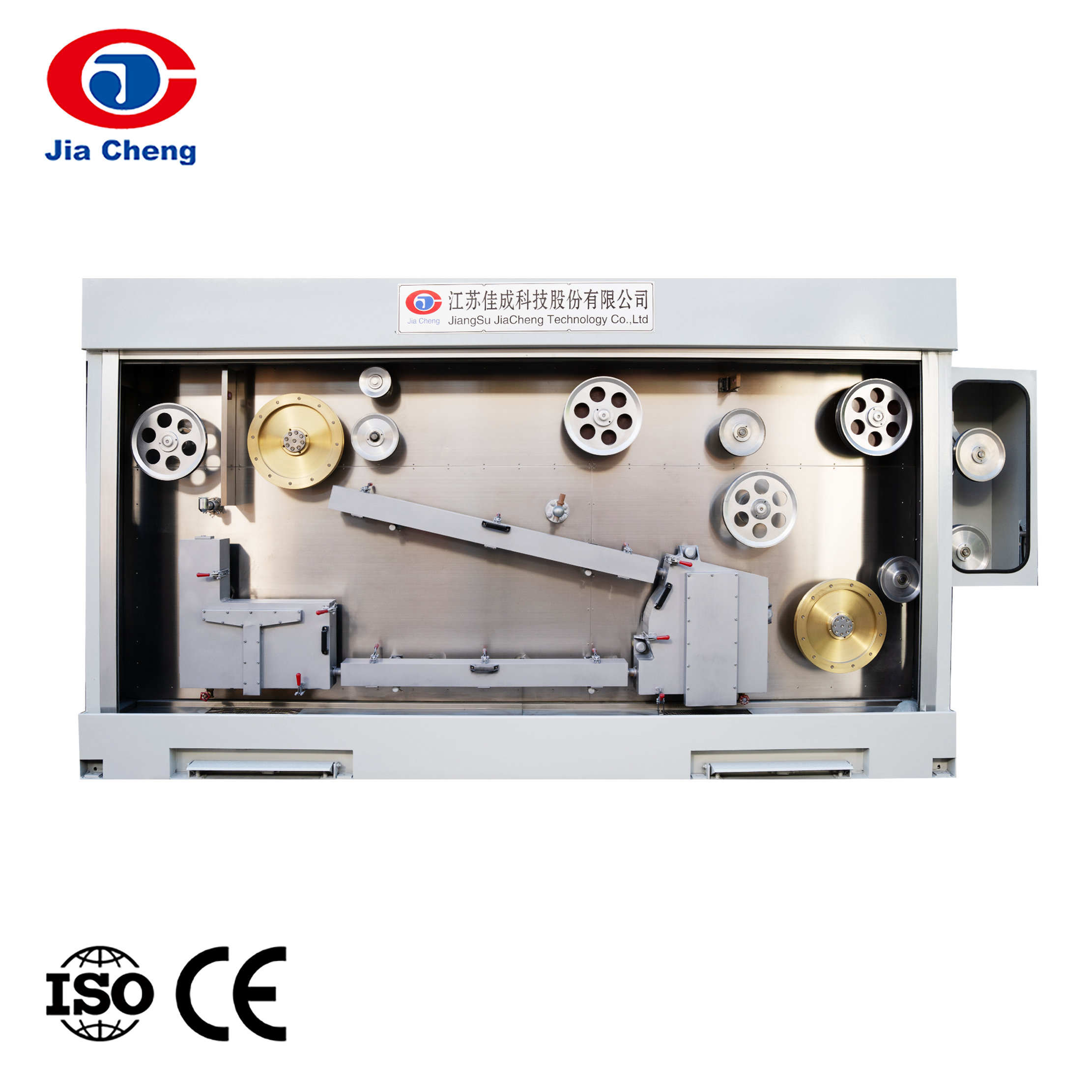
The dancer arm is the most widely used tension-sensing device on rod breakdown machines. A spring-loaded or pneumatically tensioned pivoting arm contacts the wire between two capstans. When the wire becomes too tight, the arm deflects upward; when slack develops, it drops. The arm's angular position is read by a rotary encoder or potentiometer, and this signal feeds directly into the drive controller of the upstream capstan motor, which adjusts speed in real time to restore the arm to its neutral position.
Dancer arm systems are favored for their fast mechanical response time — typically reacting within 20 to 50 milliseconds — making them effective at absorbing sudden tension spikes caused by weld points or diameter variations in the incoming rod.
Load Cell-Based Tension Measurement
More advanced rod breakdown machines incorporate strain gauge load cells mounted on deflector pulleys between capstans. The load cell measures the actual wire tension force in Newtons with high accuracy — often ±0.5% full scale — and transmits this value to the PLC or drive controller. Unlike dancer arms, load cells introduce no additional mechanical inertia into the wire path, making them preferable for very fine wire applications or high-speed operation above 20 m/s.
Closed-Loop Motor Speed Cascade Control
Modern rod breakdown machines use a cascaded speed-torque control architecture. Each capstan is driven by an individual AC motor with a variable frequency drive (VFD) or a servo drive. The master drive (typically at the take-up end) sets the reference speed, and each upstream drive operates in a follower mode, adjusting its speed based on tension feedback. This creates a synchronized chain where speed corrections propagate upstream within one control cycle, typically every 1–10 milliseconds on modern industrial PLCs.
Comparison of Tension Control Technologies
| Control Method | Response Time | Accuracy | Best Application |
|---|---|---|---|
| Dancer Arm | 20–50 ms | Moderate | Medium-speed, heavy rod drawing |
| Load Cell | <5 ms | High (±0.5%) | Fine wire, high-speed lines |
| Cascade VFD Control | 1–10 ms | Very High | Multi-pass precision drawing |
| Torque-Limiting Slip Clutch | Mechanical | Low | Legacy/low-cost machines |
The Role of Back-Tension in Die Performance and Wire Quality
Back-tension — the controlled pulling force applied to the wire entering a die — has a direct influence on die wear and wire metallurgical properties. On a rod breakdown machine, back-tension typically ranges from 10% to 40% of the drawing force, depending on the material and reduction schedule.
Higher back-tension reduces the radial pressure on the die wall, which lowers friction and extends die life by up to 30% in tungsten carbide die sets. However, excessive back-tension increases axial stress in the wire, raising the risk of center-burst defects in high-carbon steel wire. The tension control system on the rod breakdown machine must therefore operate within a narrow window — precise enough to exploit back-tension benefits without exceeding the wire's yield threshold at each reduction stage.

How Speed Compensation Handles Wire Elongation Between Passes
As the wire is drawn through each die, it elongates according to the volume constancy principle: what decreases in cross-sectional area must increase proportionally in length. A 20% area reduction increases wire length by approximately 25%, meaning each downstream capstan must rotate faster than the one before it to accommodate this growth.
The rod breakdown machine's control system pre-programs a speed ratio table based on the die reduction schedule. For example, if the wire entering a 9-die machine is at 5 m/s and experiences an average area reduction of 20% per die, the final capstan speed must be approximately 27 m/s to match the elongated wire velocity. The tension feedback loop then makes fine corrections on top of this base ratio in real time.
Tension Management During Wire Breaks and Restarts
Wire breakage is an inevitable event in rod breakdown machine operation, particularly during startup or when processing rod coils with weld joints. A well-engineered tension control system includes the following protective responses:
- Immediate upstream capstan deceleration triggered by a sudden loss of tension signal from the dancer arm or load cell.
- Sequential zone shutdown — the PLC halts capstans from the break point upstream to prevent wire pileup around dies.
- Controlled restart ramp — after rethreading, the machine accelerates through a programmable soft-start profile to gradually rebuild tension without snapping the freshly threaded wire.
On high-performance rod breakdown machines, the average wire break recovery time has been reduced to under 3 minutes through automated tension-guided restart sequences, significantly improving overall equipment effectiveness (OEE).
Integration with the Machine's HMI and Monitoring Systems
Contemporary rod breakdown machines display live inter-capstan tension values on a touchscreen HMI, allowing operators to monitor each zone's tension in real time. Key parameters typically shown include:
- Current tension value per zone (in Newtons or as a percentage of setpoint)
- Capstan speed (m/min) for each drawing block
- Motor current draw as a proxy for drawing force
- Alarm history for tension faults and wire break events
Advanced systems support OPC-UA or Modbus TCP connectivity, enabling tension data to be logged into a central SCADA or MES system for process trend analysis, quality traceability, and predictive maintenance planning. Some manufacturers now offer AI-assisted tension optimization, where historical drawing data is used to auto-adjust setpoints when switching between rod materials or die schedules.
Key Takeaways for Equipment Selection and Operation
When evaluating or operating a rod breakdown machine with respect to tension control, the following practical points deserve priority attention:
- Verify that the machine offers independent drive control per capstan block — shared gearbox systems cannot compensate for real-time tension variation.
- For drawing speeds above 15 m/s, prioritize load cell-based tension sensing over mechanical dancer arms for faster and more precise response.
- Ensure the PLC control cycle time is 10 ms or faster to handle tension fluctuations at operating speed without lag-induced wire breaks.
- Request documentation of the machine's tension setpoint range and calibration procedure for each material grade you intend to process.
- Confirm that the HMI provides per-zone tension visibility and supports data export for quality records.
Tension control is ultimately the defining factor between a rod breakdown machine that merely draws wire and one that draws wire consistently, efficiently, and with minimal breakage. Investing in a machine with a robust, multi-layered tension management architecture pays dividends through lower die consumption, reduced downtime, and tighter dimensional tolerances across every production run.
References / Sources
-
Wright, R. N. (2011). Wire Technology: Process Engineering and Metallurgy. Butterworth-Heinemann.
-
Dieter, G. E., & Schmidt, L. C. (2009). Engineering Design (4th ed.). McGraw-Hill.
-
Avitzur, B. (1983). Handbook of Metal-Forming Processes. Wiley-Interscience.
-
Valberg, H. S. (2010). Applied Metal Forming: Including FEM Analysis. Cambridge University Press.