Language
 中文简体
中文简体 English
 عربى
عربى русский
Content
Wire extrusion is the manufacturing step that puts a protective layer of polymer around a bare copper or aluminum conductor. That layer is what gives a wire its electrical insulation, its resistance to abrasion and chemicals, and often its identity for the customer — and the quality of the extruded coating determines whether a reel passes the spark test, holds its rated voltage, and keeps performing after years of bending and heat. Even a small eccentricity in the insulation wall can create a thin spot that fails under voltage stress.
For cable manufacturers, the extrusion line is often the highest-value investment on the shop floor. Selecting the right configuration matters not only for product quality but also for production flexibility, material yield, and long-term operating cost. This article explains how wire extrusion works, the key components of a modern extrusion line, the main line types, and the factors you should evaluate before making a purchase decision.
What Is Wire Extrusion?
In simple terms, wire extrusion is a continuous coating process. A thermoplastic or thermoset material is heated until it becomes a homogeneous melt, then pumped through a die where it is applied around a moving conductor. After cooling and solidification, the layer becomes either the primary insulation of the wire or the outer protective sheath of a cable core.
The term covers more than just applying plastic. Extruded compounds include PVC, PE, XLPE, LSZH, nylon, and elastomers such as silicone rubber, as well as fluoropolymers like FEP and PFA. Each material requires its own screw geometry, temperature profile, and tooling design, which is why manufacturers usually match the line configuration to a specific family of compounds rather than trying to process everything on a single machine.
How the Wire Extrusion Process Works
The process is continuous and, once set up correctly, runs at a steady line speed from reel to reel. The main stages are:
- Pay-off and tension control. The conductor is unwound from a payoff reel, or fed directly from an upstream drawing or stranding process. Tension must remain stable to avoid diameter variations in the coated wire.
- Preheating. The conductor passes through a preheater that removes surface moisture and raises its temperature, improving adhesion of the melt and reducing the cooling load on the extruder.
- Extrusion. Polymer pellets are dried, fed into the extruder hopper, melted by screw rotation and barrel heating, and delivered to the crosshead. The crosshead directs the melt around the conductor inside the die, forming a uniform layer.
- Cooling. The freshly coated wire travels through a series of water troughs. Cooling is staged so the material solidifies gradually, which prevents voids, cracks, and residual stress in the wall.
- Pulling and measurement. A capstan or caterpillar puller controls line speed. On-line diameter gauges, eccentricity monitors, and spark testers check the product in real time before it reaches the take-up.
- Take-up. The finished wire is wound onto reels, with traverse control ensuring even winding and consistent tension from core to flange.
Line speed and melt temperature are interdependent. Increasing speed raises shear heating in the screw, while higher temperature lowers melt viscosity. A well-designed line keeps that balance steady; otherwise you get diameter fluctuations that the gauges can detect but cannot fully correct.
Main Components of a Cable Extrusion Line
Regardless of the manufacturer, the architecture of an extrusion line follows the same logic. Understanding each component helps you compare quotes and spot where a low-cost bid may have cut corners.
| Component | Function | Impact on product |
|---|---|---|
| Extruder (barrel and screw) | Melts and homogenizes the polymer, builds melt pressure | Affects output stability, melt temperature, and compound quality |
| Crosshead and tooling (die and tip) | Directs the melt around the conductor | Sets wall thickness, concentricity, and surface finish |
| Preheater | Heats the conductor before coating | Improves adhesion and reduces thermal shock |
| Cooling troughs | Solidifies the melt in controlled stages | Prevents voids, ovality, and shrinkage marks |
| Capstan or puller | Sets line speed and maintains tension | Keeps diameter tolerances stable over long runs |
| Diameter gauge and spark tester | Monitors wall thickness and insulation integrity | Enables real-time correction and final quality assurance |
| Take-up | Winds the finished wire onto reels | Protects the product surface and controls package quality |
In practical terms, the screw and the tooling are the two parts that most influence product quality. A screw designed for soft PVC will not process crosslinkable PE with the same efficiency, and a worn tip will immediately show up as eccentricity in the finished wire.
Types of Extrusion Lines for Different Cable Constructions
Not all cables need the same extrusion configuration. The required layer structure and compound determine which line type makes sense.
Insulation and Sheath Lines
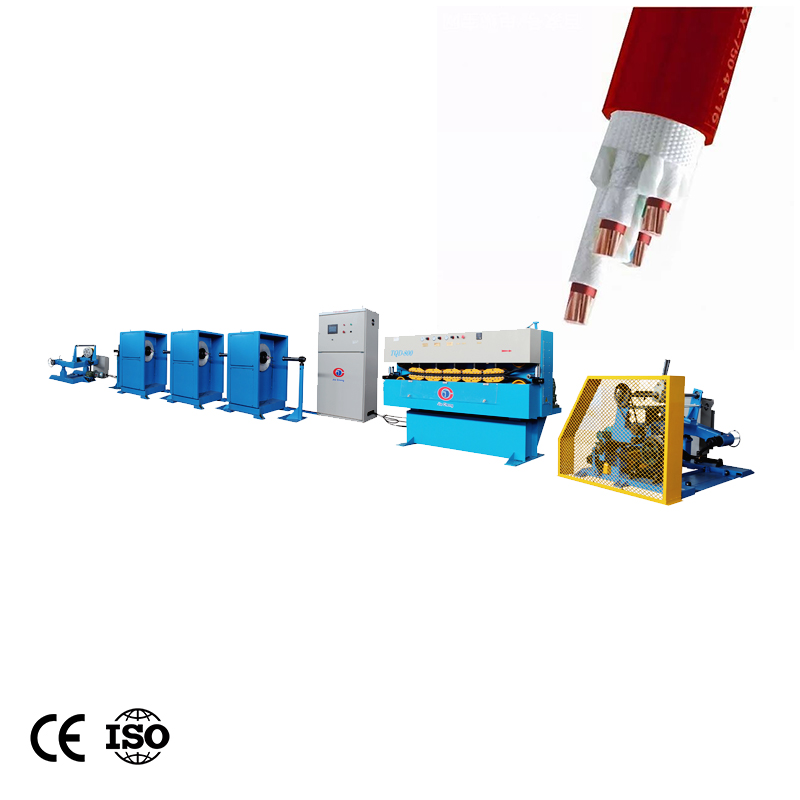
Most cable plants run a general-purpose line for solid insulation and a separate line, or at least a different screw set, for sheath extrusion. Insulation applications require precise wall thickness control because capacitance and dielectric strength are geometry-dependent. Sheath lines handle larger cross-sections and thicker walls, often processing darker or highly filled compounds that would contaminate an insulation line. Jiacheng offers a high-speed wire insulation production line for thin-wall insulation work and a cable sheath extruder machine for outer jacket applications, so the two jobs do not have to compete for the same equipment.
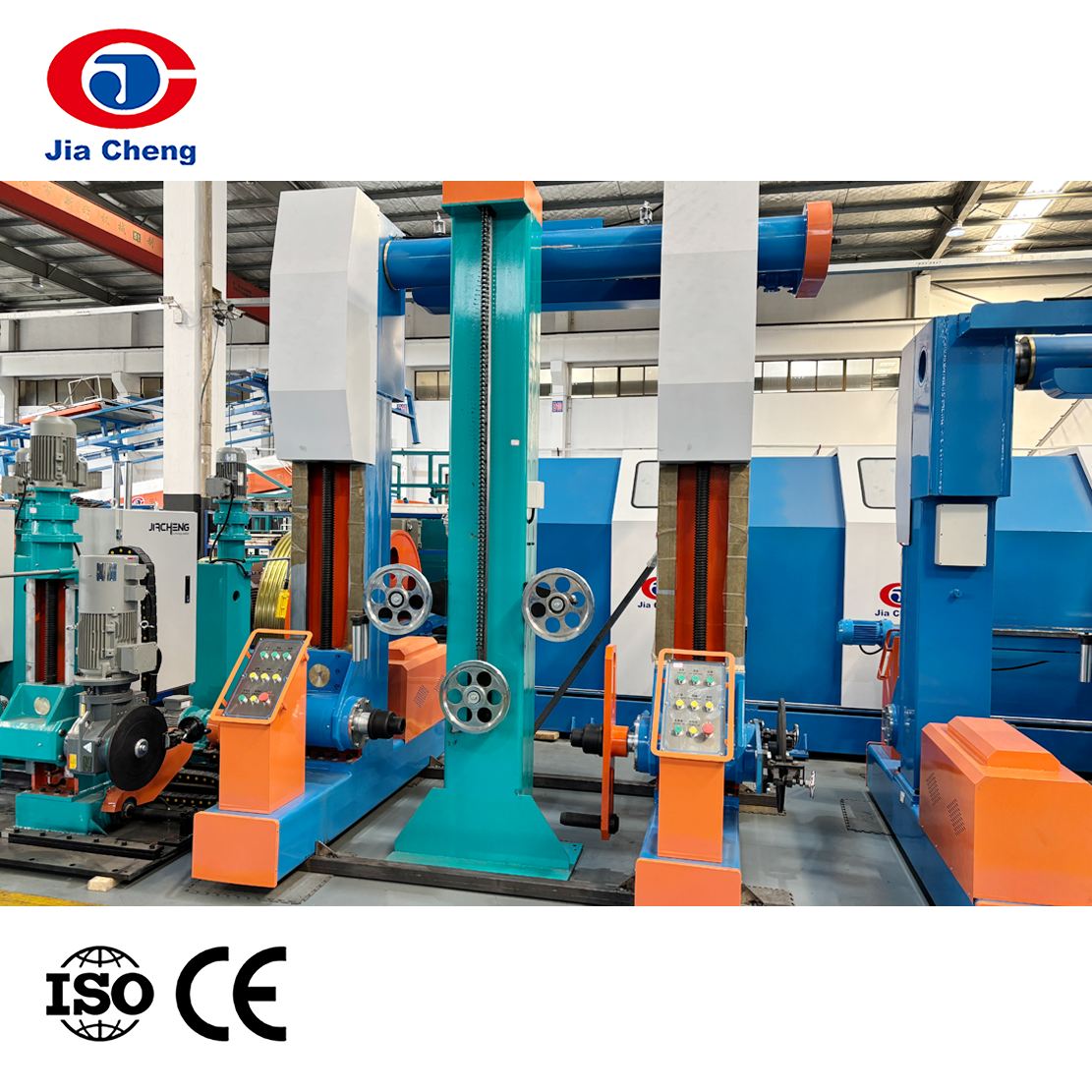 Custom Cable Sheath Extruder Machine Factory, Manufacturers - Jiangsu Jiacheng TJiangsu Jiacheng Technology Co., Ltd. is China Cable Sheath Extruder Machine manufacturers and factory, we offer custom Cable Sheath Extr...View Product →
 Custom High Speed Wire Insulation Production Line Factory, Manufacturers - JiangJiangsu Jiacheng Technology Co., Ltd. is China High Speed Wire Insulation Production Line manufacturers and factory, we offer custom High...View Product →
Multi-Layer Coextrusion Lines
Cables with a conductor screen, insulation, and insulation screen — typical of medium- and high-voltage power cables — require two or three extruders feeding one head so the layers are applied in a single pass. Coextrusion avoids contamination between layers and improves adhesion at each interface. A dedicated double or triple layer coextrusion production line is the standard solution for these constructions.
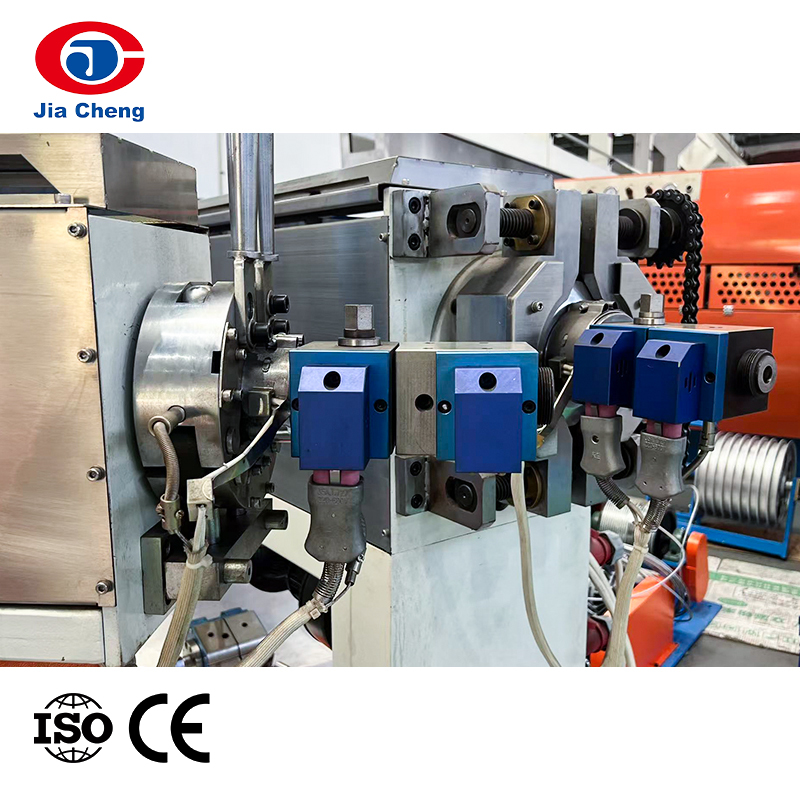 Custom Double Triple Layers Co-Extrusion Production Line Factory, Manufacturers Jiangsu Jiacheng Technology Co., Ltd. is China Double Triple Layers Co-Extrusion Production Line manufacturers and factory, we offer cust...View Product →
Crosslinked and Foamed Insulation Lines
XLPE cables need a heated, pressurized curing section (CCV or similar) between the extruder and the cooling trough, because the material must crosslink above its melting point before it cools. Foamed insulation, used in RF and data cables, requires gas injection or a chemical blowing agent, with carefully controlled temperature to achieve a consistent cell structure. These lines are more specialized and are usually selected for a defined product family rather than for general-purpose work.
Specialty Material Lines
Silicone rubber and fluoropolymer compounds expand the product range of a cable plant but demand their own processing conditions. Silicone lines run at high extrusion speeds and use an infrared or hot-air curing section, while fluoropolymers need corrosion-resistant screw and barrel materials because of the aggressive decomposition products generated at high processing temperatures.
Technical Factors That Define Extrusion Quality
Three parameters deserve attention when you evaluate an extrusion line, because they explain most quality problems in practice.
Draw-down ratio (DDR). DDR compares the cross-sectional area of the die opening with the cross-section of the finished insulated wire. A properly matched DDR — typically between 1.2 and 2.5 depending on the polymer — ensures that the melt is shaped smoothly onto the conductor without sagging or melt fracture.
Concentricity. Eccentricity, expressed as a percentage, measures how far the conductor sits from the center of the insulation wall. Poor concentricity leads to thin spots that fail under voltage stress or repeated bending. It is influenced by tooling alignment, guide tip centering, and the uniformity of melt flow around the conductor.
Melt temperature control. Barrel temperature setpoints and screw design determine the melt temperature at the head. A temperature that is too high degrades the polymer, producing black specks and odor; one that is too low leaves the melt poorly homogenized, showing up as diameter variation downstream. On-line melt pressure and temperature sensors let the operator keep the process inside a narrow window.
How to Choose a Wire Extrusion Line
Once the process basics are clear, the purchase decision comes down to a practical checklist rather than a single headline specification.
- Define the conductor range and line speed. A line designed for 0.5 to 2.5 mm² building wire is different from one for 120 to 300 mm² power cables. Line speed determines productivity, but only as long as the cooling section and take-up can keep up.
- Match the screw and barrel to the materials. If the product plan includes XLPE, silicone rubber, or foamed insulation, buy the line with the corresponding screw design, barrel length, and curing section from the start.
- Consider the measurement package early. On-line diameter and eccentricity monitoring should be treated as part of the line, not an optional add-on, because they directly affect scrap rate.
- Check the supplier's supporting processes. Extrusion is only one step in cable production. A supplier that also builds wire drawing, stranding, and testing equipment can integrate the line with the rest of the factory and take responsibility for the whole process.
The upstream processes matter just as much as the extruder itself. Conductor diameter variations from the drawing machine cannot be fixed by the extrusion die; they simply pass through as wall-thickness fluctuation. That is why manufacturers pay close attention to tension control on rod breakdown machines and to the accuracy of intermediate wire drawing before the conductor ever enters the extruder.
Jiangsu Jiacheng Technology Co., Ltd. supplies the full range of wire extrusion lines — from high-speed insulation lines to sheath extruders, coextrusion lines, XLPE curing lines, and specialty silicone and fluoropolymer lines — as part of a complete cable equipment portfolio that starts with copper rod upcasting and continues through drawing, stranding, extrusion, testing, and packing. For manufacturers planning a new plant or a major expansion, buying the extrusion stage together with the rest of the process gives you one interface for installation, commissioning, and spare parts, and it shortens the time needed to reach stable production. You can read more about this approach in our overview of one-stop solutions for cable production.