Language
 中文简体
 English
 عربى
 русский
Content
- 1 What Wire Gauge Diameter Actually Measures
- 2 How AWG Numbers Turn Into Diameters
- 3 Why Diameter Matters More Than the Gauge Label
- 4 Stranded Wire: Same Gauge, Different Diameter
- 5 How to Measure Wire Gauge Diameter Accurately
- 6 Where Diameter Is Created: From Rod to Final Gauge
- 7 Common Mistakes When Reading a Wire Gauge Chart
- 8 A Short Checklist Before You Specify or Order
Wire gauge diameter is one of those measurements that looks simple on a spec sheet and then causes arguments on the factory floor. The gauge number printed on a spool, a drawing schedule, or a terminal datasheet rarely tells you the actual size in millimetres or inches. This guide connects the dots: what AWG really means, how diameter changes from one gauge step to the next, where the standard stops being helpful, and how cable makers keep that diameter under control from copper rod to finished conductor.
What Wire Gauge Diameter Actually Measures
Gauge is a standard. Diameter is a physical fact. The American Wire Gauge system, usually shortened to AWG, defines the diameters of round, solid, nonferrous, electrically conducting wire. When someone asks about "wire gauge diameter," they normally want the physical size behind a particular gauge number, expressed in inches or millimetres.
The first thing to clarify is which diameter you mean. A solid conductor has one diameter. A stranded conductor has two: the diameter of each individual strand and the overall diameter of the completed bundle. An insulated wire adds a third: the outside diameter of the finished product, including insulation, shielding, and jacket. These values can differ by several millimetres even when the gauge number stays the same.
In purchasing and production, that distinction matters. A 22 AWG bare conductor and a 22 AWG finished wire are not interchangeable. One is a copper dimension; the other is a cable that has to fit a terminal, a conduit, or a connector cavity.
How AWG Numbers Turn Into Diameters
AWG works on a logarithmic scale. Each step of three gauge numbers roughly halves the cross-sectional area, and each step of six gauge numbers roughly halves the diameter. Moving from a larger number to a smaller number means a thicker wire: 14 AWG is larger than 18 AWG, and 4/0 AWG is much larger than both.
The system has two anchor points. 36 AWG is defined as 0.005 inches, and 0000 AWG is defined as 0.4600 inches. Between them, the ratio between consecutive sizes is about 1.1229 in diameter and about 1.261 in area. The relationship can be written as:
Diameter in inches = 0.005 × 92(36 − AWG) / 39
Once you have a diameter, area follows from the circle formula. That is why the same reference chart can show diameter, circular mil area, and resistance per unit length — they are three views of the same geometry.
| AWG | Diameter (mm) | Diameter (in) | Typical use |
|---|---|---|---|
| 0000 | 11.684 | 0.4600 | Large power feeders |
| 2 | 6.544 | 0.2576 | Service entrance cable |
| 6 | 4.115 | 0.1620 | Ranges and feeders |
| 10 | 2.588 | 0.1019 | 30 A circuits |
| 12 | 2.053 | 0.0808 | 20 A branch circuits |
| 14 | 1.628 | 0.0641 | 15 A lighting circuits |
| 18 | 1.024 | 0.0403 | Control and fixture wire |
| 22 | 0.6438 | 0.0253 | Electronics and signals |
| 28 | 0.3200 | 0.0126 | Low-current data |
| 36 | 0.1270 | 0.0050 | Fine instrumentation |
Why Diameter Matters More Than the Gauge Label
Two wires can share the same gauge number and still behave differently if their actual diameters sit at opposite ends of the tolerance band. Resistance rises as diameter falls, because resistance is inversely proportional to cross-sectional area. A conductor that is slightly under size will run warmer, drop more voltage, and consume more energy over a long run.
Diameter also controls fit. Crimp terminals, insulation displacement connectors, cable glands, and conduits are all designed around a specific size range. A wire that is nominally 12 AWG but measures closer to 13 AWG may pass a pull test and still fail a dimensional inspection.
For the cable manufacturer, the issue continues downstream. The extrusion die that forms insulation has to be matched to the actual conductor diameter, not the nominal gauge. If the conductor arrives under size, the insulation wall becomes thicker than specified; if it arrives over size, the wall thins. Either way, the finished cable may fall outside its own tolerance.
Stranded Wire: Same Gauge, Different Diameter
Stranded conductors complicate the picture because they have both a strand diameter and an overall diameter. A 12 AWG stranded conductor might use 19 strands of a smaller gauge, or 7 strands of a larger one, and both constructions can be called 12 AWG. The overall diameter of the finished bundle is larger than a solid conductor of the same gauge, while the total copper area stays close to the nominal value.
Construction type matters as well. Bunched conductors are loose and flexible. Concentric-stranded conductors are more orderly. Compacted and compressed conductors are rolled or drawn after stranding to reduce the overall diameter and create a smoother surface. That is why two cables with identical gauge labels can have noticeably different outside diameters.
How to Measure Wire Gauge Diameter Accurately
For a bare solid conductor, a calibrated micrometer is still the simplest tool. Strip the insulation carefully, remove any nicks or burrs, and measure across the conductor at three points spaced along its length. Rotate the wire between measurements to catch ovality. Take the average, and compare it with the gauge chart rather than trusting a single reading.
For fine wires below roughly 30 AWG, a hand micrometer can crush the conductor or read inconsistently. An optical comparator or a non-contact laser diameter gauge is a better choice. Laser gauges also work on moving wire, which makes them useful for inline monitoring during drawing, annealing, and extrusion.
Temperature and tension matter more than most people expect. Copper expands with heat, and a wire under tension may read slightly smaller than it does at rest. For incoming inspection, let the sample stabilise at room temperature and measure it in a relaxed state.
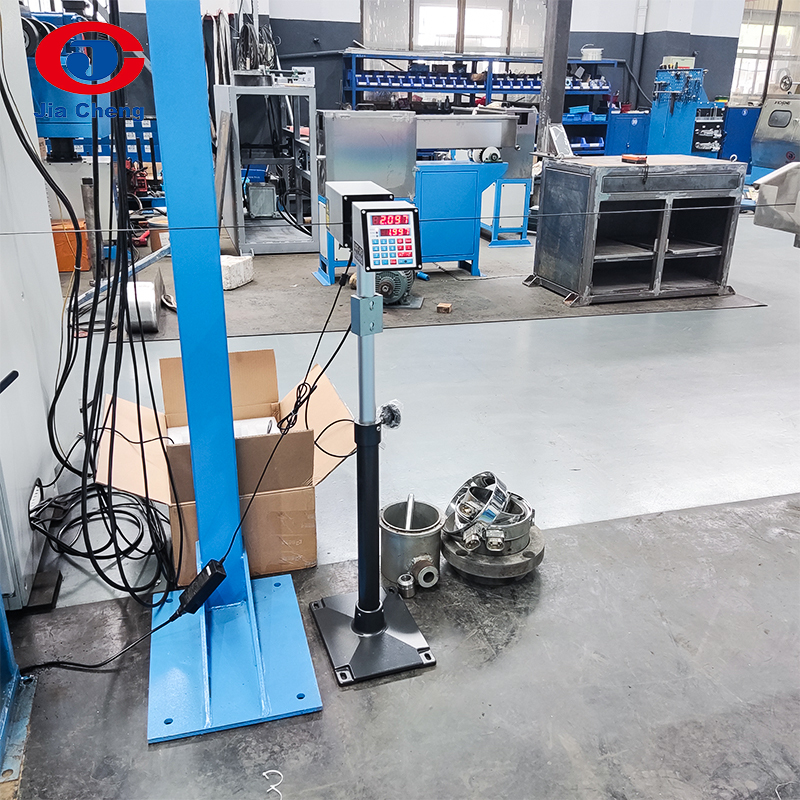 LGD-25 Diameter Gauge for Wire and Cable MeasurementUseful for checking wire and cable diameters after drawing stages, with a 0.100–25.000 mm range.View Product →
Where Diameter Is Created: From Rod to Final Gauge
Wire gauge diameter is not set by a single machine. It is the result of a sequence that starts with copper or aluminium rod and ends with a finished conductor. Rod breakdown machines take 8 mm rod down to roughly 3 mm or 4 mm in a few passes. Intermediate and fine drawing machines continue the reduction through progressively smaller dies, and an inline annealer restores the ductility that cold working removes.
Each die changes the diameter, so die wear, lubricant quality, and capstan speed all show up in the final measurement. A worn die produces an oversized conductor. A slipping capstan or an unstable annealer can create diameter variation along the length of a spool, which is far harder to detect than a single out-of-tolerance point.
After drawing, stranding and bunching determine the overall diameter of the conductor bundle. Extrusion then adds insulation and jacket layers around that bundle. At every stage, the previous diameter becomes the starting point for the next process, which is why a small error early in the line tends to grow rather than disappear. A copper rod to finished wire production line is designed as one continuous chain for exactly this reason.
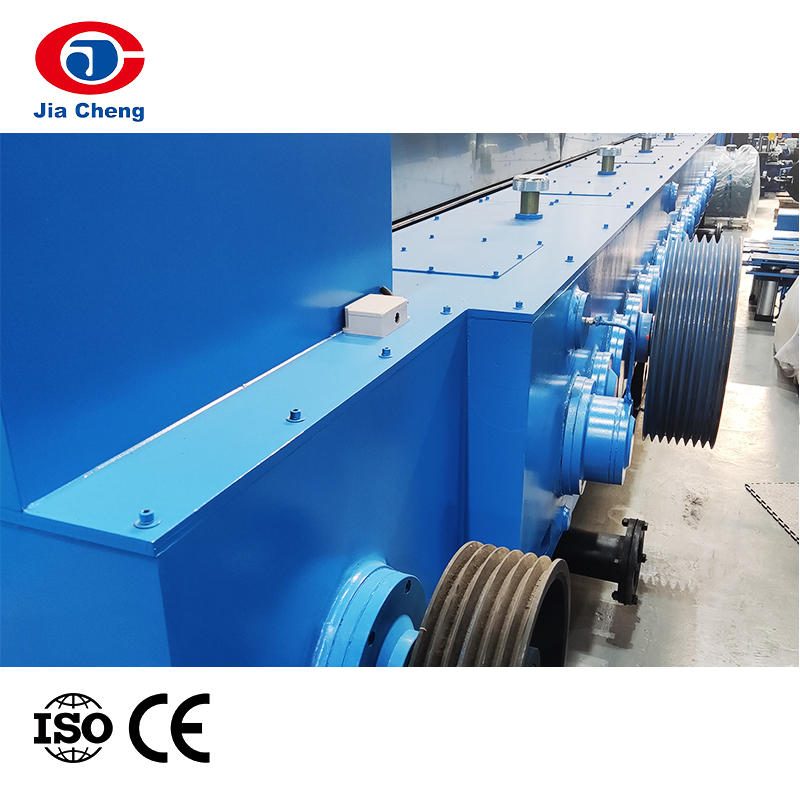 LHT450 Copper Rod Breakdown Machine for Wire Drawing LinesDraws copper rod from 8 mm down to 1.2–4.0 mm in a continuous line with annealing and dual-bobbin take-up.View Product →
 Fine Wire Drawing Machine with Inline Annealer for Copper WireCombines drawing and annealing on one line for copper wire, supporting two wires and speeds up to 1800 m/min.View Product →
If you are comparing drawing equipment, our practical guide on how to choose a copper wire drawing machine walks through the questions that matter most: incoming rod size, finished gauge range, number of wires, annealing requirements, and the tolerance the downstream process can accept.
Common Mistakes When Reading a Wire Gauge Chart
- Confusing conductor diameter with overall cable diameter. The chart value usually refers to the metal, not the finished wire.
- Mixing gauge systems. AWG, SWG, and metric gauges use different scales, and the same number can mean very different sizes.
- Applying solid-conductor values to stranded wire. The strand bundle is normally a little larger than the equivalent solid diameter.
- Rounding too early. Converting from inches to millimetres and then rounding can shift a borderline conductor out of tolerance.
- Ignoring the tolerance band. A nominal diameter is a target, not a guarantee; the acceptable range is what actually matters.
A Short Checklist Before You Specify or Order
- Decide whether you need conductor diameter, strand diameter, or finished cable diameter.
- Confirm the gauge system and the units used by your supplier or standard.
- Check the tolerance range, not just the nominal value.
- For stranded wire, note the strand count, strand gauge, and construction type.
- Verify that the specified diameter fits the terminal, conduit, or connector you plan to use.
- For production runs, confirm how the diameter will be measured and how often it will be recorded.
Wire gauge diameter is ultimately a manufacturing variable, not just a reference number. The chart gives you the target, but the drawing dies, annealing settings, stranding configuration, and extrusion tooling decide whether the wire actually lands on that target. At Jiacheng, we have spent years building equipment for each stage of that chain, from rod breakdown and fine drawing to annealing, stranding, extrusion, and testing. If you are working through a diameter problem on your line, we are happy to talk through the process with you and help you find the right starting point.